Galaxy in Ursa Major
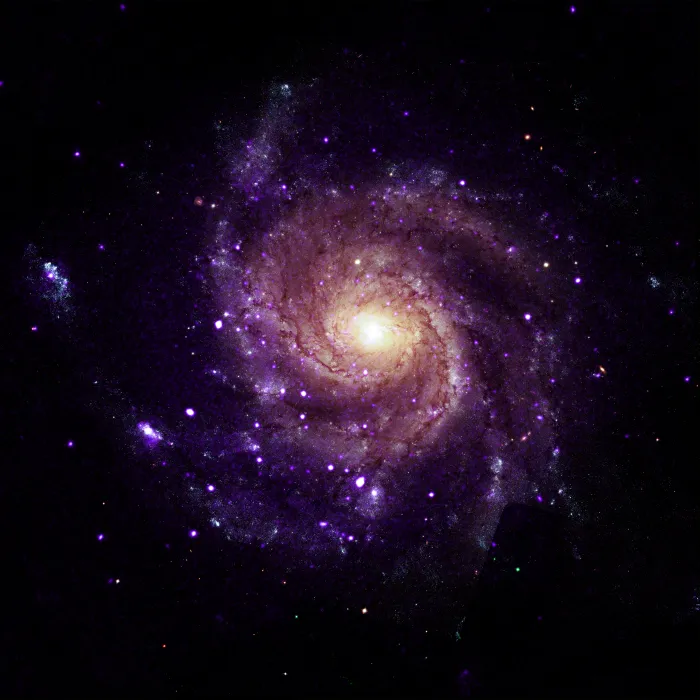
Pinwheel Galaxy (M101)
A vast face-on spiral, nearly twice the width of our own galaxy, and notoriously disappointing at the eyepiece for exactly that reason — all that light spread across a Moon-sized area amounts to very little per square arcminute. Give it a dark sky and low power, or do not bother.
It is also markedly lopsided, its arms pulled out of symmetry by the small galaxies around it, and it has produced a supernova visible in binoculars as recently as 2023. About a trillion stars, spread thin enough that the eyepiece gives you almost none of them.
- Catalogue
- M101
- Type
- Galaxy
- Constellation
- Ursa Major
- Distance
- 21 million light-years
- Apparent magnitude
- 7.9
- Surface brightness
- 23.6 mag/□″
- Apparent size
- 27′ × 26′
- Right ascension
- 14h 03m
- Declination
- +54.35°
- Found by
- Pierre Méchain, 1781
Magnitude 7.9 sounds comfortable and is spread over 27′, which brings it down to 23.6 per square arcsecond — the number that actually decides whether there is anything to see. Why surface brightness is the number that matters.
Could you see it?
Nothing in the common range of amateur equipment makes this straightforward under any sky — it is a photographic target, or one for patience and a very large aperture.
| Sky | Eye | 10×50 | 80mm | 130mm | 200mm |
|---|---|---|---|---|---|
| Bortle 1 21.9 mag/□″ | No | Challenge | Challenge | Challenge | Challenge |
| Bortle 2 21.7 mag/□″ | No | Challenge | Challenge | Challenge | Challenge |
| Bortle 3 21.4 mag/□″ | No | Challenge | Challenge | Challenge | Challenge |
| Bortle 4 20.9 mag/□″ | No | Challenge | Challenge | Challenge | Challenge |
| Bortle 5 20.3 mag/□″ | No | No | No | No | No |
| Bortle 6 19.3 mag/□″ | No | No | No | No | No |
| Bortle 7 18.6 mag/□″ | No | No | No | No | No |
| Bortle 8 18.1 mag/□″ | No | No | No | No | No |
| Bortle 9 17.8 mag/□″ | No | No | No | No | No |
At the eyepiece
The classic case of a galaxy that photographs magnificently and disappoints at the eyepiece. Use the lowest power you have and a genuinely dark sky, and it becomes a large, faint, round glow with knots in it. Any light pollution at all and there is nothing there.
When, and from where
Highest in the middle of the night in April. Well placed for the northern hemisphere and overhead for anyone near 54°N. South of 36°S it stays below the horizon.
| Latitude | Highest it gets | |
|---|---|---|
| 60°N Oslo, Anchorage | 84° | Never sets |
| 51°N London, Calgary | 87° | Never sets |
| 40°N New York, Madrid | 76° | Never sets |
| 30°N Cairo, Houston | 66° | |
| 0°N the equator | 36° | |
| 33°S Sydney, Cape Town | 3° | Low — in the murk |
In the archive
Nearby in the sky
The whole catalogue →Nothing else in the catalogue is especially close; the nearest is 8.9° apart, which is a separate trip rather than a nudge of the tube. Everything below is measured from M101 itself, not from the middle of Ursa Major.
- M51 Whirlpool Galaxy 8.9° apart Canes Venatici · magnitude 8.4 · binoculars from Bortle 5 or darker
- M102 Spindle Galaxy 9.2° apart Draco · magnitude 9.9 · binoculars from Bortle 4 or darker
- M40 Winnecke 4 14° apart Ursa Major · magnitude 8.4 · binoculars from Bortle 7 or darker
- M63 Sunflower Galaxy 15° apart Canes Venatici · magnitude 8.6 · binoculars from Bortle 5 or darker
One of 110. Positions J2000; the sky is the final authority.