Telescopes & Instruments
Diving into an Out-of-sync Galaxy
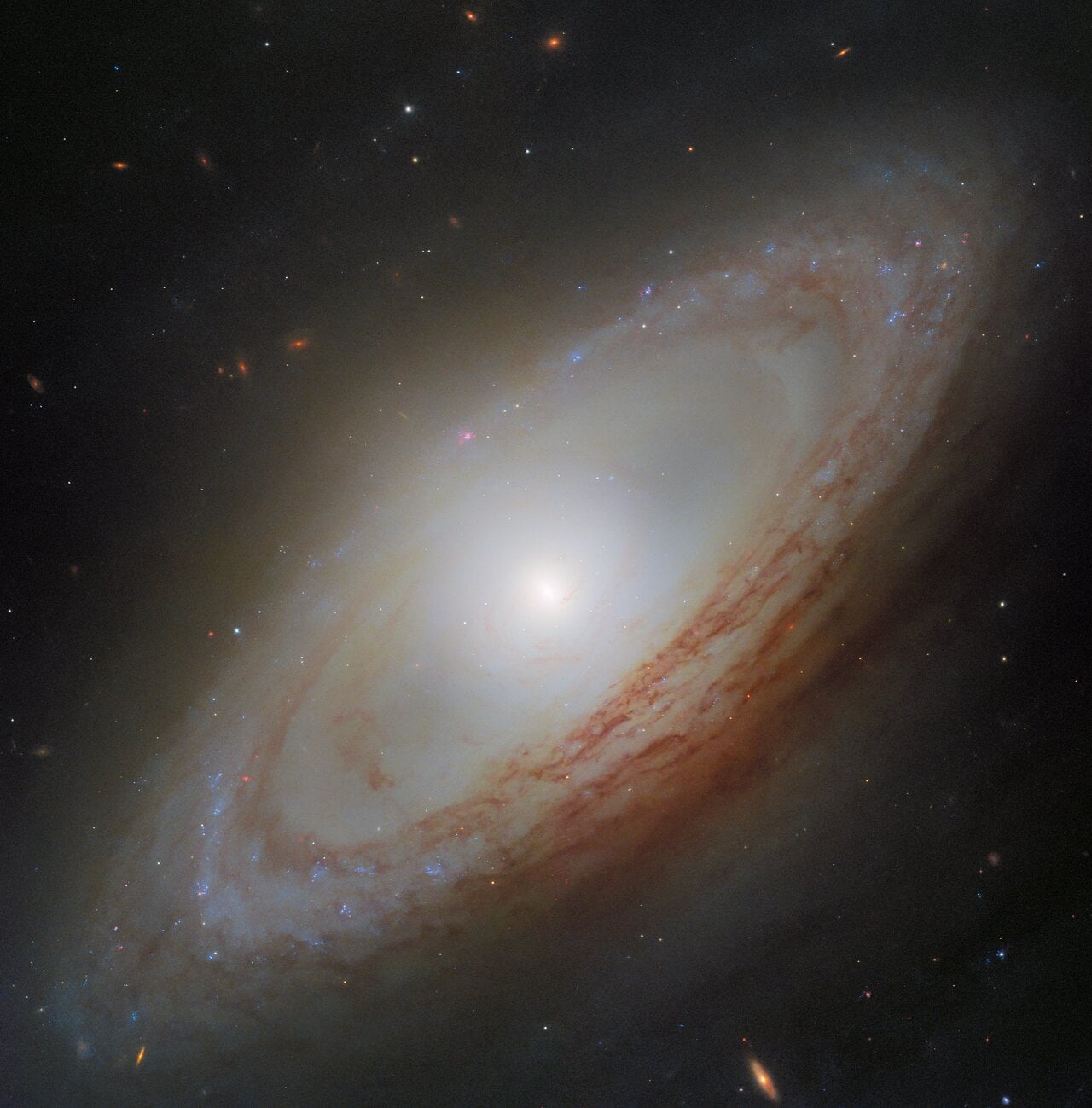
Galaxies are like snowflakes, no two exactly alike, even the spirals. The Hubble Space Telescope did a visual dive into the distant spiral NGC 4693 and found some…
Deep Field
Starting
Hβ · 486.1 nm
Observatory construction, instrument commissioning, first light, survey data releases, and the funding fights that decide which of them get built.
Astronomy is instrument-limited, and always has been. Resolution scales with aperture and light-gathering with its square, which is why every generation builds bigger and why the 39-metre Extremely Large Telescope under construction in Chile will collect about a hundred times the light of a 4-metre. Above about eight metres a single mirror cannot be cast or supported, so everything larger is segmented and held in alignment to tens of nanometres by active optics.
On the ground the atmosphere blurs a point of light into a disc about an arcsecond across — enough to erase most of what a large mirror bought you. Adaptive optics fixes it by measuring the distortion against a bright reference and deforming a small mirror a thousand times a second to cancel it, and where there is no bright star nearby, one is manufactured by firing a laser into the sodium layer ninety kilometres up. That is the reason ground-based telescopes can compete with space at all, and it explains where observatories are: high, so there is less air above; dry, because water vapour absorbs infrared; and on a coast with a cold current offshore, because that produces the stable layered airflow the correction works best in. Cerro Paranal and Mauna Kea are not compromises between science and politics. They are the two or three places on Earth where the sky behaves.
The other axis of progress is cadence. Vera Rubin Observatory will image the whole southern sky every few nights for ten years, and the instrument is almost the easy part — it will generate on the order of ten million alerts a night, every one a thing that changed, and no human will look at any of them. What that requires is a pipeline that decides in seconds which changes are a supernova, which are an asteroid and which are a satellite crossing the frame, and hands the interesting ones to somebody with a telescope free. It is a different discipline from pointing at one object for a night, and it is the direction most of the field is moving.
Computed from each site's latitude — the same arithmetic the place pages carry.
16 of them south of the equator, which is a long way from half and is not an accident
the galactic centre reaches 90° from there — the higher it climbs, the less air you are looking through
sites far enough from the equator that the Sun never drops eighteen degrees below the horizon for part of the year
observatories with no atmosphere to look through, which is the only way to fix the problem rather than avoid it
Telescopes & Instruments
Galaxies are like snowflakes, no two exactly alike, even the spirals. The Hubble Space Telescope did a visual dive into the distant spiral NGC 4693 and found some…
Tarter: To figure out how to find life beyond Earth, we need to put life on Earth into a larger context.
JWST has revealed that young planetary systems lose their planet-building gas through a changing mix of powerful jets, molecular winds, and radiation-driven…
Scientists love taking inspiration from nature. The evolutionary processes that have created such a diverse panoply of life on Earth can be…
biosignature: A biological marker of life. For example, DNA. Drake Equation: A simple equation used to estimate the abundance of intelligent and…

Astronomers have identified what may be the first example of a new class of radio galaxy, one whose central black hole appears…
NASA’s Neil Gehrels Swift Observatory has resumed use of its third science instrument and automatically repointing to examine new high-energy flashes in…
EDWIN POWELL HUBBLE November 20, 1889-September 28, 1953 from an article by N.U. Mayallin BIOGRAPHICAL MEMOIRS NAS 41 Courtesy NASA SpaceLink Edwin…
THE JOURNAL OF THE ROYAL ASTRONOMICAL SOCIETY OF CANADA JOURNAL DE LA SOCIÉTÉ ROYALE D ASTRONOMIE DU CANADA Vol. 83, No.
From the Proceedings of the National Academy of SciencesVolume 15 : March 15, 1929 : Number 3 THE…
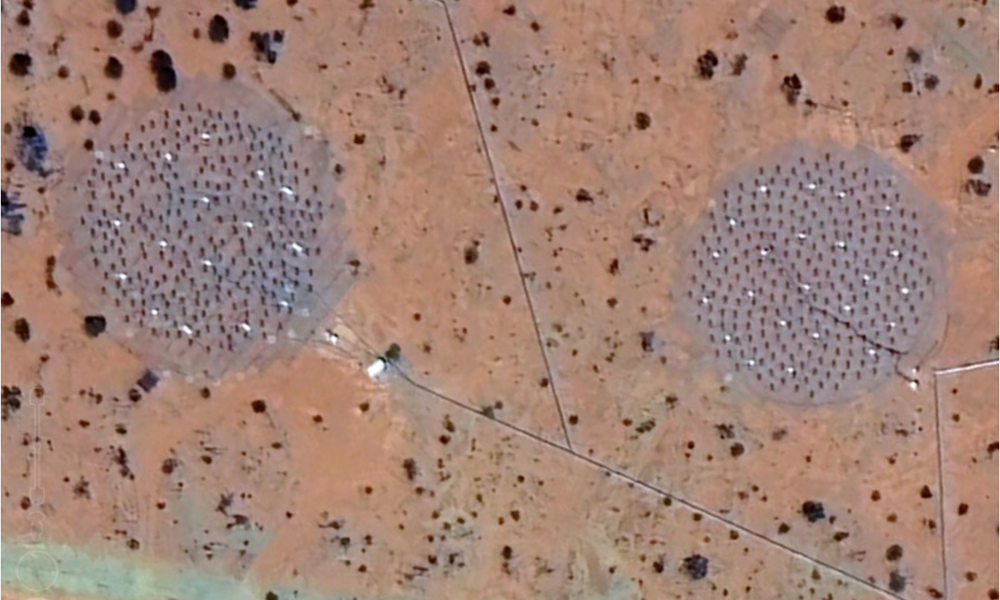
SKA-Low is a radio telescope under construction in Western Australia. It will operate across a wide frequency range…
Using the James Webb Space Telescope (JWST), a team of astronomers led by the University of Maryland identified…
The robotic spacecraft that failed to rescue an aging NASA telescope plunged back to Earth on Friday less…
A chaotic secret hides within this seemingly serene image of spiral galaxy NGC 4698 taken by NASA’s Hubble…
NASA has now confirmed all ground stations supporting the agency’s Nancy Grace Roman Space Telescope are ready to…
Cosmic Origins Second Early Career Workshop. 20-22 October 2026
The UltraViolet EXplorer (UVEX). Speakers: Dan Weisz (UCB) and Suvi Gezari (UMD)
Once it goes through a confirmation review, the observatory can proceed into construction. The 5.
The round follows a $70M Series B in September 2025, and brings Hubble’s total financing to $300M to…
Galaxies and their stars in the early Universe look a lot weirder than those we see today, and…
NASA ·
APOD · NASA — public domain ·
ESO ·
This is the actual list telescopes & instruments is matched on — nothing hidden and nothing inferred. A term on the top line settles it on its own; the second line counts, but needs company. A story that matches nothing here stays untagged rather than being pushed somewhere to fill a gap. How sorting works →
james webb space telescopehubble space telescopevera rubin observatoryextremely large telescopenancy grace romanfirst lightadaptive opticsinterferometerradio telescopesquare kilometre arraychandra x-rayspectrographobservatory constructiondata releasevery large telescopealma arrayevent horizon telescope
jwstwebb telescopehubbletelescopeobservatoryinstrument commissioningground-based observatorymirror segmentdetector arraysurvey telescopegaia missionxrismeuclid