Exoplanets & Life
October’s Night Sky Notes: Spooky Stargazing
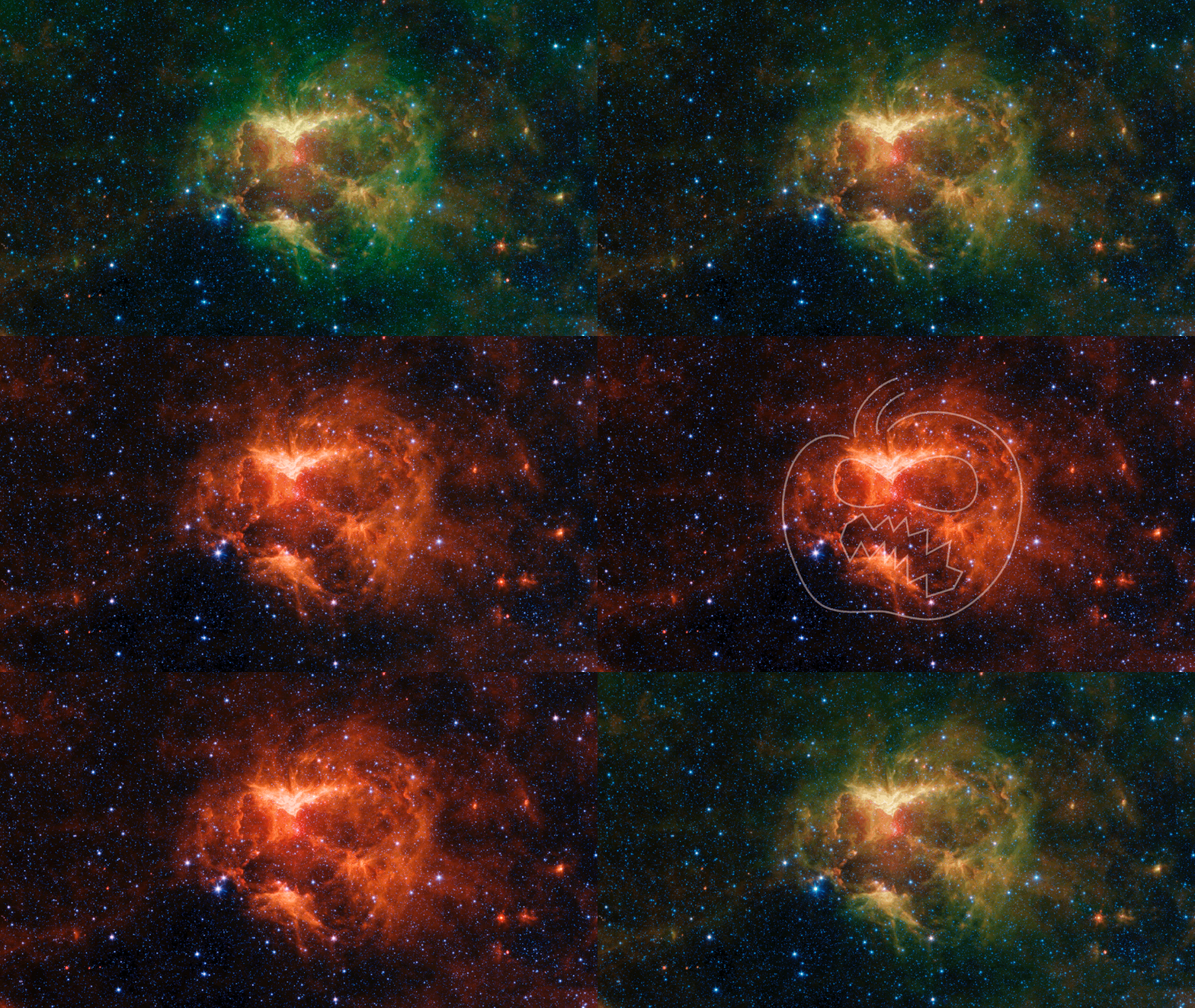
The Ghoul Located within the constellation Perseus lies a star called Algol, also known as ‘Demon Star’ or ‘The Ghoul’.
Deep Field
Starting
H₂O · 1.4 µm
Detections, atmospheres and habitability — transit and radial-velocity results, JWST spectroscopy, biosignature claims, and the careful walking-back that usually follows.
Thirty years ago the number of confirmed planets outside the solar system was zero. It is now over five thousand, and the field has moved from discovery to characterisation. Two methods found most of them: transits, where a planet crossing its star dims it by a fraction of a percent, and radial velocity, where the planet's gravity makes the star wobble by metres per second. Between them they give size and mass, and therefore density — the difference between a rock and a gas ball.
Both methods are strongly biased, and the catalogue is a portrait of the bias as much as of the galaxy. A transit requires the orbit to be edge-on from here, which for an Earth-like orbit is about a half-percent chance, and it repeats on the orbital period — so a survey that runs for four years finds planets with years shorter than four years, and Jupiter analogues almost by accident. Radial velocity favours heavy planets close in, for the same reason a heavier child on a roundabout is easier to notice. Correcting for all of that is how the field arrives at statements about how common planets are, and those corrections are where the arguments live. The genuine surprise survived them: most systems look nothing like ours. Hot Jupiters orbit in days, and sub-Neptunes — the single most common planet type in the galaxy — have no local example at all.
The current frontier is atmospheres, read from starlight filtered through them during a transit, which is what Webb was built for. It is a hard measurement: the signal is a few parts in ten thousand, and the star's own spots and flares imprint themselves on it. Webb has cleanly detected carbon dioxide, sulphur dioxide and evidence of photochemistry on hot giant planets, which is real progress. It has also produced the field's most public argument, over whether a possible biosignature on a sub-Neptune is a molecule or a data-reduction choice. That is the honest state of things: the instrument is good enough to start the conversation about life and not yet good enough to end one.
Exoplanets & Life
The Ghoul Located within the constellation Perseus lies a star called Algol, also known as ‘Demon Star’ or ‘The Ghoul’.
L. C. Mayorga et al 2026 AJ 172 87 Analysis of Cassini spectra of Titan suggests that JWST is unlikely to identify…
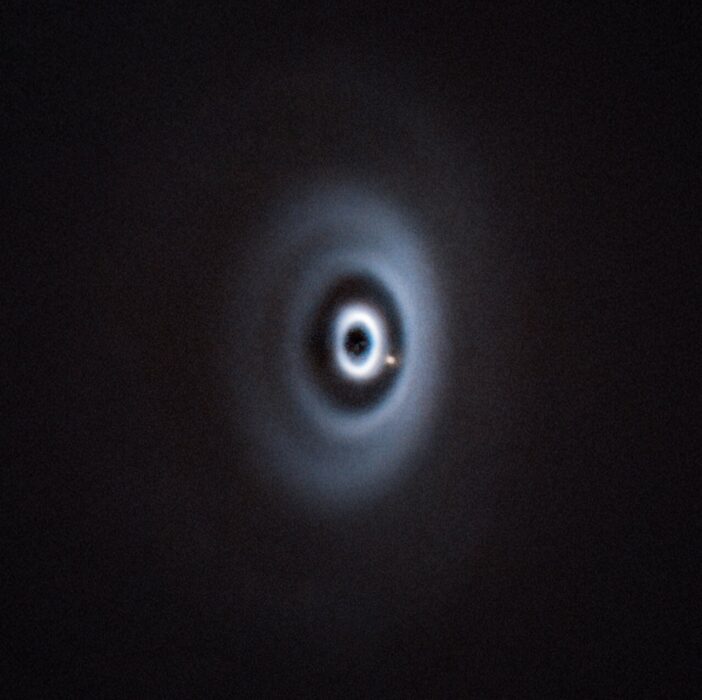
New radio observations provide the best view yet of the WISPIT 2 planetary system, revealing spiral wakes driven by a growing young…

The Komodo dragon is the world’s largest lizard. It's a venomous predator that can hunt, swim between islands and reproduce without a…
1920: Scale of the Universe Debate History & brief summaries: About the 1920 Greate Debate | Wikipedia | This Month in Astronomical…
biosignature: A biological marker of life. For example, DNA. Drake Equation: A simple equation used to estimate the abundance of intelligent and…
From the Proceedings of the National Academy of SciencesVolume 15 : March 15, 1929 : Number 3 THE LARGE RADIAL VELOCITY OF…
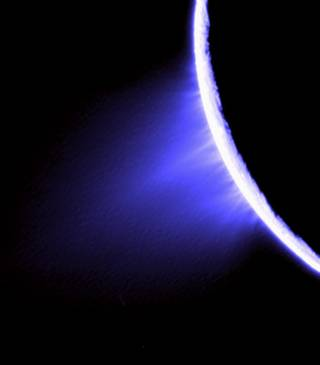
KMT-2023-BLG-1118L b is a gas giant exoplanet that orbits a -type star. Its mass is 0.21 Jupiters, it takes 2.
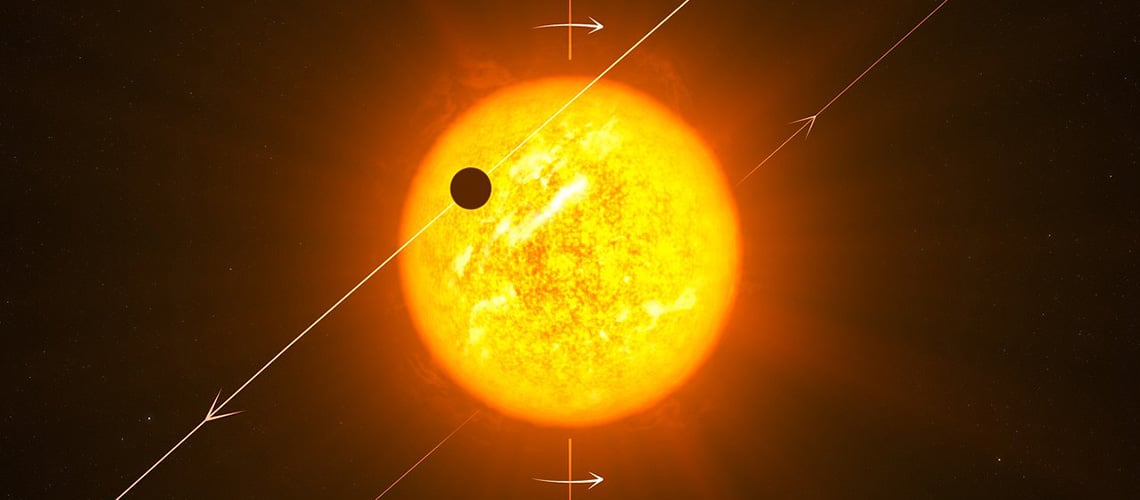
In our own solar system, all eight planets orbit our Sun in a nice, orderly fashion.
Researchers use stellar pulsations to detect substellar companions around A-type stars — including what could be a first-of-its-kind…
In the search for extraterrestrial life, it makes sense to first look for rocky planets with an atmosphere…
Director: Center for SETI ResearchSETI Institute, 1984 – 2012Emeritus Chair for SETI Research How will humanity first discover…
Professor: Biology, Earth & Space Sciences, U. WashingtonAuthor: Rare Earth: Why Complex Life is Uncommon in the Universe(w/D.
Mengjie Li et al 2026 ApJS 285 26 Using light curves from the Transiting Exoplanet Survey Satellite (TESS)…
Visualization research has long focused on representing places people already inhabit.
Agricultural emissions represent an important and understudied part of Earth’s land and atmosphere systems.
We are seeking virtual panelists and external reviewers for Habitable Worlds Observatory Precursor Science Investigations (ROSES D.8).
Studying exoplanets has given astronomers insights into the characteristics that could help them find life beyond Earth.
Conditions on early Earth may have become stable enough to sustain the chemistry associated with the origins of…
Astronomers have discovered the youngest-known exoplanet so far, Elias 2-24 b.
NASA ·
APOD · NASA — public domain ·
ESO ·
This is the actual list exoplanets & life is matched on — nothing hidden and nothing inferred. A term on the top line settles it on its own; the second line counts, but needs company. A story that matches nothing here stays untagged rather than being pushed somewhere to fill a gap. How sorting works →
exoplanetsuper-earthsub-neptunehot jupiterhabitable zonebiosignaturetransit methodradial velocitytrappist-1proxima bplanetary atmosphereastrobiologytechnosignaturek2-18btransiting planetprotoplanetary diskprotoplanetary disc
tess missionkepler missionplato missionariel missionalien worldextrasolarcircumstellargoldilocks zonesetiexomoonrocky planet