
The Sun & Space Weather
Did space weather delay a train in 1841?
It would have been the earliest example of space weather impacting human technology, but an international team of researchers found a slight problem
Deep Field
Starting
He II · 30.4 nm
Solar physics and its consequences: sunspot cycles, coronal observations, radiation events, and the space-weather forecasts that satellite and grid operators actually read.
The Sun is a variable star on an eleven-year cycle, and the variability reaches us. Flares release X-rays that arrive in eight minutes and black out high-frequency radio on the daylit side. Coronal mass ejections throw a billion tonnes of magnetised plasma outward, and if one is aimed correctly it compresses Earth's magnetic field a day or two later, producing aurora far from the poles, extra drag on satellites in low orbit, and induced currents in power grids and pipelines.
Forecasting it is possible but only just. The warning comes from a handful of spacecraft parked at the L1 point, a million and a half kilometres upstream, where the solar wind passes them fifteen to sixty minutes before it reaches us. That is enough to trip a grid operator into a safe configuration and not much else; the direction of the field embedded in the cloud, which decides whether the storm couples to Earth's field at all or slides past it, is not reliably known until the cloud arrives. So a forecast is a probability rather than a schedule, and the operational products read like weather did in the 1950s. The Carrington event of 1859 set telegraph offices on fire. A repeat would be considerably more expensive, and the estimates for how expensive vary by an order of magnitude, which is itself the finding.
That is why a fleet does nothing but watch. SOHO has been at L1 since 1995; SDO images the disc every few seconds; Solar Orbiter is climbing out of the ecliptic to look at the poles, which no instrument had properly seen; and Parker Solar Probe flies through the corona itself at nearly 700,000 kilometres an hour, close enough that its heat shield does the work its instruments cannot. Parker answered one long-standing question by finding the switchbacks — sharp reversals in the magnetic field — that appear to be part of how the corona gets to a million degrees while the surface below it sits at six thousand. It has not answered why. Space weather remains the one branch of astronomy with an operational forecast office, and the only one where being wrong costs somebody money the same week.
NOAA's numbers, on this gather. The cycle position is arithmetic from the 2019 minimum and is approximate.
Quiet. Nothing to see outside the usual auroral zone. · 24-hour maximum 1.7. Five is a storm; nine has set telegraph offices on fire
the highest probability anywhere in the model, which is almost always over ocean or ice rather than anywhere anybody lives
the background level; a flare is graded on the same scale, each letter ten times the last
about 6.8 years into an eleven-year average — the declining phase, where the biggest storms historically happen
The auroral oval, drawn, and the rest of the space weather →
The Sun & Space Weather
It would have been the earliest example of space weather impacting human technology, but an international team of researchers found a slight problem

Sun news September 28, 2026: The coronal hole stream has faded, and the sun stayed quiet with only small C flares.

East Aurora, NY — Moog Inc. (NYSE: MOG.A and MOG.B) announced the completion and commissioning of a new ISO Class 8 certified…
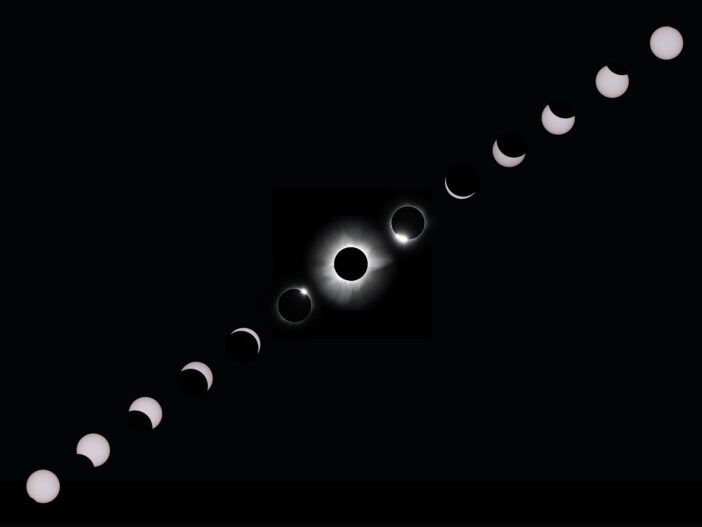
Handwritten eclipse observations and sketches of solar prominences from 1733 offer researchers a rare window into a data-poor period of solar history.

The Van Allen radiation belts are huge, doughnut-shaped regions of highly energetic charged particles trapped by Earth's magnetosphere.
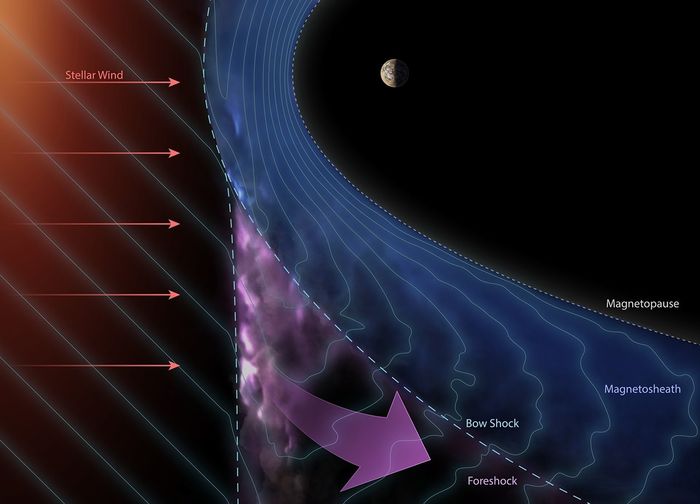
Heliophysics Research Strategy: Bold Science in Action NASA’s heliophysics strategic objective is to understand the Sun and its interactions with Earth and…

Poster | Grades 6-12+ | This three-poster series teaches foundational heliophysics: from solar cycles to space weather, integrated with traditional Navajo ways…

Poster | Grades 6-12+ | This poster examines how solar radiation drives Earth's climate, weather systems, and the biological processes that sustain…

The sun's magnetic fields are a twisty, curvy, ever-changing mess. In particular, our star's polar regions host areas called polar coronal holes…
Also covered by Universe Today
The Sun’s magnetic fields are a twisty, curvy, ever changing mess. In particular, our star’s polar regions host…
We have long known that the Sun is active. It “flares” quite often, sending huge amounts of energy…
The sun is such a constant in our lives that it can be difficult to imagine our star…
The 2026 September equinox occurs at 00:05 UTC on September 23, 2026.
When the solar system first took up the task of building solid bodies—such as planets, moons and protoplanets—it…
Astronomer Sandra Chapman has found a connection between the quiet period of one solar cycle and the active…
Here are some of the forms of aurora that you might see.
There's an aurora season around the equinoxes, due to the way the magnetic fields of the sun and…
The Space Weather Living History project captures, documents and preserves the living history of space weather, and aims…
Helio and You This article series for educators aims to engage learners of all ages with the exciting…
The Solar TErrestrial RElations Observatory (STEREO) mission was launched to help us see the Sun from a new…
NASA ·
APOD · NASA — public domain ·
ESO ·
This is the actual list the sun & space weather is matched on — nothing hidden and nothing inferred. A term on the top line settles it on its own; the second line counts, but needs company. A story that matches nothing here stays untagged rather than being pushed somewhere to fill a gap. How sorting works →
solar flarecoronal mass ejectionspace weathergeomagnetic stormsunspotsolar cycleaurora borealisaurora australissolar windparker solar probesolar orbiterheliospheresolar maximumcoronal holex-class flaresolar prominence
auroranorthern lightscoronaheliophysicssolar dynamics observatoryradiation beltmagnetospheresolar eclipseannular eclipsepath of totalitytotalityphotospherechromospherebailyfirst contact