Open cluster in Taurus
Pleiades (M45)
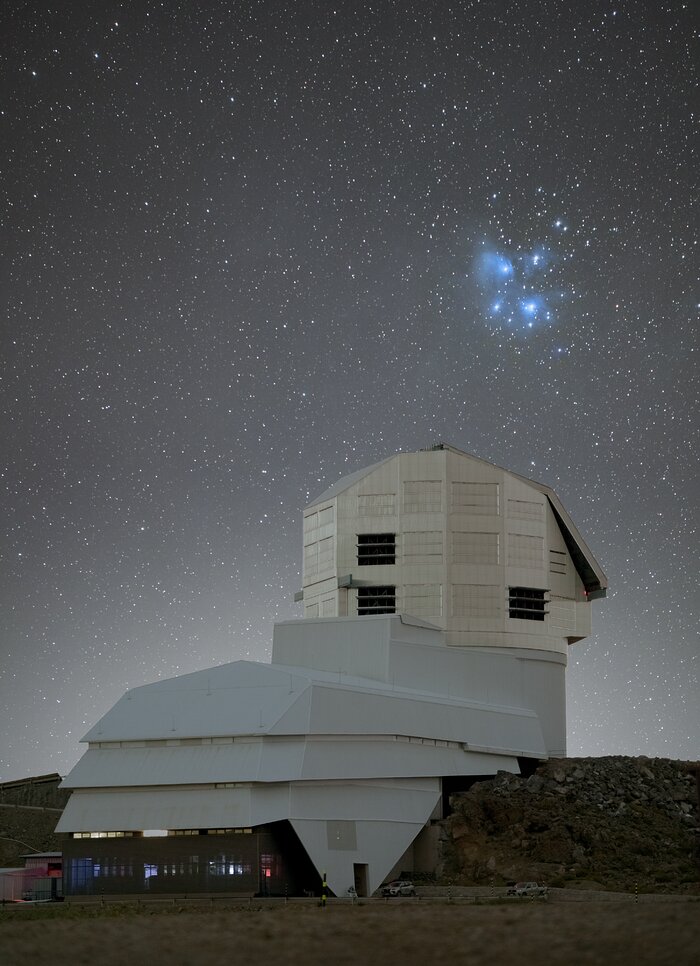
The Pleiades, recorded by every culture that has ever written anything down. Most people see six stars and the traditional count is seven, which has generated three thousand years of speculation about a lost sister; the likeliest explanation is that Pleione is variable and has faded.
The blue haze around the brightest stars is not the gas they formed from — that dispersed long ago — but an unrelated dust cloud the cluster happens to be ploughing through. At perhaps a hundred million years the Pleiades are young enough that everything in them is still hot and blue, and in a few hundred million more they will have scattered entirely.
- Catalogue
- M45
- Type
- Open cluster
- Constellation
- Taurus
- Distance
- 444 light-years
- Apparent magnitude
- 1.2
- Surface brightness
- 20.0 mag/□″
- Apparent size
- 110′
- Right ascension
- 3h 47m
- Declination
- +24.12°
- Found by
- Known since antiquity
Magnitude 1.2 for the cluster as a whole, though that is a sum rather than a thing you see: what reaches you is a scatter of separate stars, and whether you catch it depends on how bright the brightest of them are. Why surface brightness is the number that matters.
Could you see it?
Bright enough for any sky there is, including the middle of a city. One of the few things on this list of which that is true.
| Sky | Eye | 10×50 | 80mm | 130mm | 200mm |
|---|---|---|---|---|---|
| Bortle 1 21.9 mag/□″ | Easy | Easy | Easy | Easy | Easy |
| Bortle 2 21.7 mag/□″ | Easy | Easy | Easy | Easy | Easy |
| Bortle 3 21.4 mag/□″ | Easy | Easy | Easy | Easy | Easy |
| Bortle 4 20.9 mag/□″ | Easy | Easy | Easy | Easy | Easy |
| Bortle 5 20.3 mag/□″ | Easy | Easy | Easy | Easy | Easy |
| Bortle 6 19.3 mag/□″ | Easy | Easy | Easy | Easy | Easy |
| Bortle 7 18.6 mag/□″ | Easy | Easy | Easy | Easy | Easy |
| Bortle 8 18.1 mag/□″ | Easy | Easy | Easy | Easy | Easy |
| Bortle 9 17.8 mag/□″ | Easy | Easy | Easy | Easy | Easy |
At the eyepiece
The one deep-sky object that is better without any equipment at all. Binoculars show the full extent and the fainter members; a telescope shows a few bright stars and loses the shape entirely. The nebulosity around Merope is real but needs a dark sky and low power, and photographs exaggerate it badly.
When, and from where
Highest in the middle of the night in November. Passes overhead at 24°N and rises from everywhere except the far south — below 66°S it never clears the horizon.
| Latitude | Highest it gets | |
|---|---|---|
| 60°N Oslo, Anchorage | 54° | |
| 51°N London, Calgary | 63° | |
| 40°N New York, Madrid | 74° | |
| 30°N Cairo, Houston | 84° | |
| 0°N the equator | 66° | |
| 33°S Sydney, Cape Town | 33° |
In the archive
Nearby in the sky
The whole catalogue →Nothing else in the catalogue is especially close; the nearest is 23° apart, which is a separate trip rather than a nudge of the tube. Everything below is measured from M45 itself, not from the middle of Taurus.
- M34 Open cluster 23° apart Perseus · magnitude 5.5 · binoculars from Bortle 9 or darker
- M1 Crab Nebula 25° apart Taurus · magnitude 8.4 · binoculars from Bortle 5 or darker
- M38 Open cluster 25° apart Auriga · magnitude 7.4 · binoculars from Bortle 9 or darker
- M36 Open cluster 26° apart Auriga · magnitude 6.3 · binoculars from Bortle 9 or darker
One of 110. Positions J2000; the sky is the final authority.