Galaxy in Coma Berenices
Black Eye Galaxy (M64)
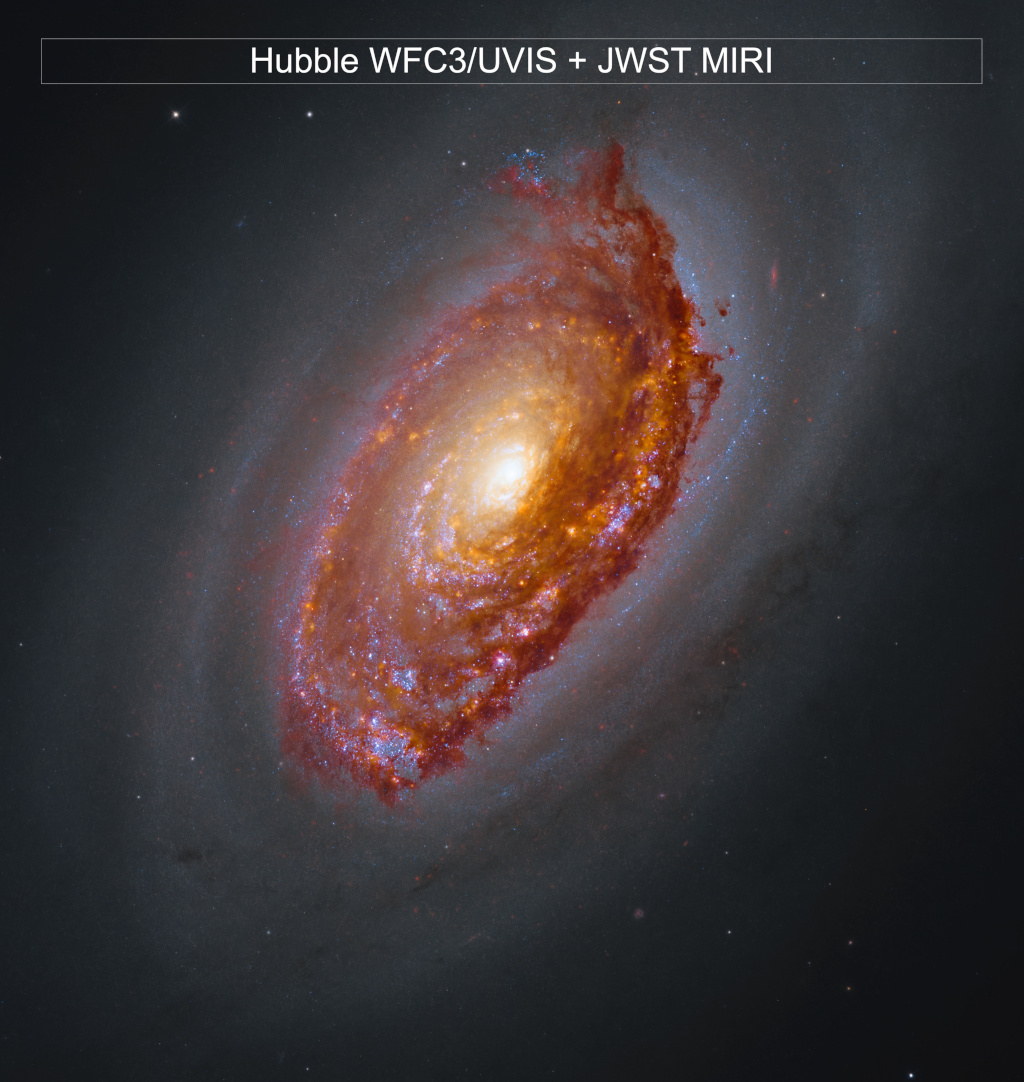
The Black Eye, for a bank of dust lying across the front of the core and close enough to make out in a 150mm. Stranger is what the gas does: the outer parts turn one way and the inner parts the other, the unfinished business of a merger a billion years back.
The counter-rotation is confined to the gas: the inner disc turns one way out to about three thousand light-years, and everything beyond that turns the other. Where the two shear against each other is exactly where new stars are forming, which is the clearest available picture of what a galaxy does with material it has swallowed.
- Catalogue
- M64
- Type
- Galaxy
- Constellation
- Coma Berenices
- Distance
- 24 million light-years
- Apparent magnitude
- 8.5
- Surface brightness
- 21.3 mag/□″
- Apparent size
- 9′ × 5′
- Right ascension
- 12h 57m
- Declination
- +21.68°
- Found by
- Edward Pigott, 1779
Small enough that its 8.5 magnitudes arrive concentrated rather than smeared: 21.3 per square arcsecond, which is why it stands out from the sky better than its brightness alone suggests. Why surface brightness is the number that matters.
Could you see it?
Straightforward with 10×50 binoculars from Bortle 5.
| Sky | Eye | 10×50 | 80mm | 130mm | 200mm |
|---|---|---|---|---|---|
| Bortle 1 21.9 mag/□″ | No | Easy | Easy | Easy | Easy |
| Bortle 2 21.7 mag/□″ | No | Easy | Easy | Easy | Easy |
| Bortle 3 21.4 mag/□″ | No | Easy | Easy | Easy | Easy |
| Bortle 4 20.9 mag/□″ | No | Easy | Easy | Easy | Easy |
| Bortle 5 20.3 mag/□″ | No | Easy | Easy | Easy | Easy |
| Bortle 6 19.3 mag/□″ | No | Challenge | Challenge | Challenge | Challenge |
| Bortle 7 18.6 mag/□″ | No | Challenge | Challenge | Challenge | Challenge |
| Bortle 8 18.1 mag/□″ | No | No | No | No | No |
| Bortle 9 17.8 mag/□″ | No | No | No | No | No |
At the eyepiece
Rare among galaxies in that you can actually see the dust. Give it 150mm and a decent sky and the dark band across the northern side of the core is there, unmistakable once found. That makes this the best galaxy on the list for anyone who wants structure rather than a smudge.
When, and from where
Highest in the middle of the night in April. Passes overhead at 22°N and rises from everywhere except the far south — below 68°S it never clears the horizon.
| Latitude | Highest it gets | |
|---|---|---|
| 60°N Oslo, Anchorage | 52° | |
| 51°N London, Calgary | 61° | |
| 40°N New York, Madrid | 72° | |
| 30°N Cairo, Houston | 82° | |
| 0°N the equator | 68° | |
| 33°S Sydney, Cape Town | 35° |
In the archive
Nearby in the sky
The whole catalogue →Nothing else in the catalogue is especially close; the nearest is 5.2° apart, which is a separate trip rather than a nudge of the tube. Everything below is measured from M64 itself, not from the middle of Coma Berenices.
- M53 Globular cluster 5.2° apart Coma Berenices · magnitude 7.6 · binoculars from Bortle 5 or darker
- M85 Galaxy 8.1° apart Coma Berenices · magnitude 9.1 · binoculars from Bortle 5 or darker
- M91 Galaxy 8.8° apart Coma Berenices · magnitude 10.2 · binoculars from Bortle 3 or darker
- M88 Galaxy 9.3° apart Coma Berenices · magnitude 9.6 · binoculars from Bortle 5 or darker
One of 110. Positions J2000; the sky is the final authority.