Nebula in Sagittarius
Lagoon Nebula (M8)
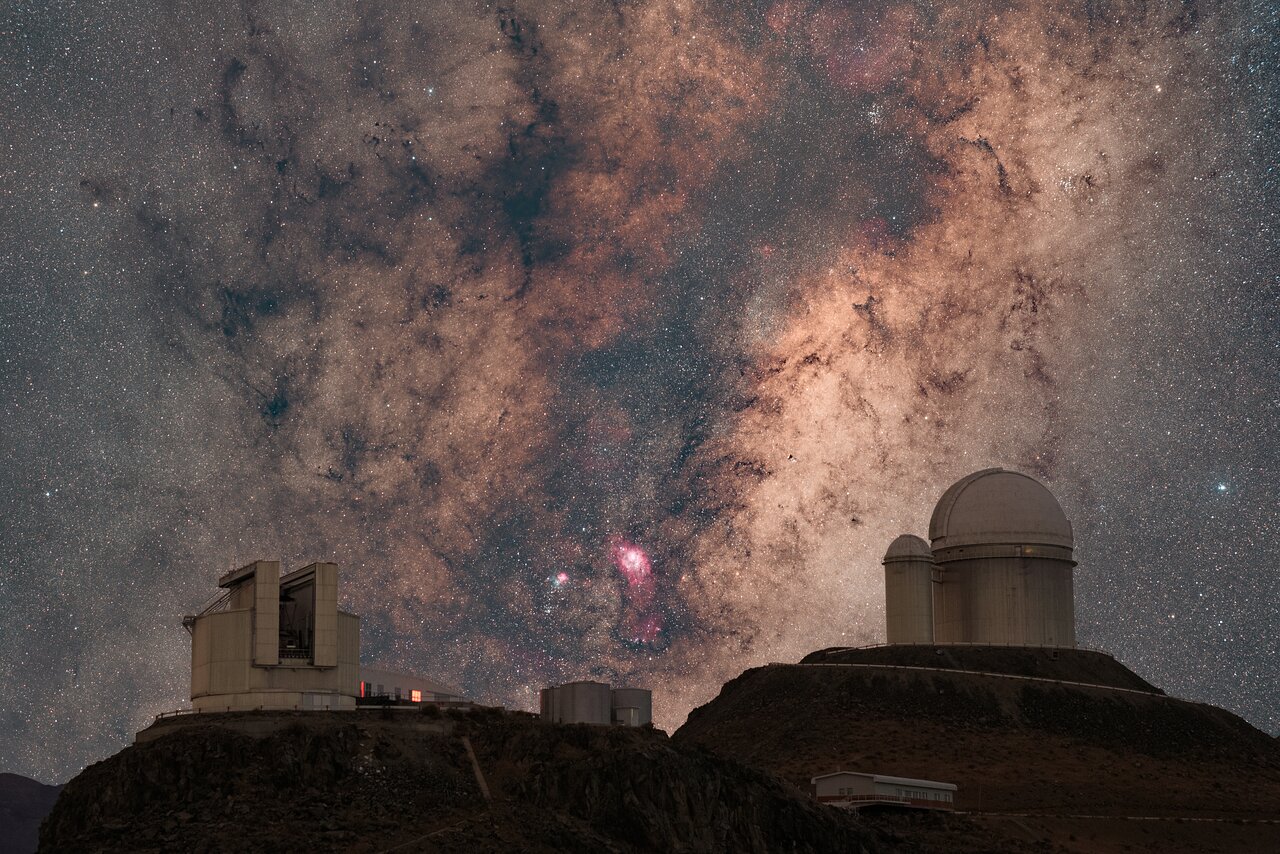
The dark lane that gives the Lagoon its name is not a gap in the cloud but a bank of dust in front of it. The cluster glowing inside was built out of this same gas within the last few million years — a nebula caught halfway through becoming stars.
Inside it, near the brightest part, is the Hourglass: a knot of gas being blasted into shape by a single star, Herschel 36, hot enough to light the whole complex. The Lagoon is ninety arcminutes across, which means binoculars serve it better than a telescope does.
- Catalogue
- M8
- Type
- Nebula
- Constellation
- Sagittarius
- Distance
- 4,100 light-years
- Apparent magnitude
- 4.6
- Surface brightness
- 22.1 mag/□″
- Apparent size
- 90′ × 40′
- Right ascension
- 18h 04m
- Declination
- −24.38°
- Found by
- Giovanni Batista Hodierna, before 1654
Magnitude 4.6 sounds comfortable and is spread over 90′, which brings it down to 22.1 per square arcsecond — the number that actually decides whether there is anything to see. Why surface brightness is the number that matters.
Could you see it?
Straightforward from a Bortle 3 sky or darker, and aperture makes almost no difference to that — spread this thinly, an object is limited by how bright the sky behind it is rather than by how much light the telescope collects. A darker site beats a bigger telescope.
| Sky | Eye | 10×50 | 80mm | 130mm | 200mm |
|---|---|---|---|---|---|
| Bortle 1 21.9 mag/□″ | Easy | Easy | Easy | Easy | Easy |
| Bortle 2 21.7 mag/□″ | Easy | Easy | Easy | Easy | Easy |
| Bortle 3 21.4 mag/□″ | Easy | Easy | Easy | Easy | Easy |
| Bortle 4 20.9 mag/□″ | Challenge | Challenge | Challenge | Challenge | Challenge |
| Bortle 5 20.3 mag/□″ | Challenge | Challenge | Challenge | Challenge | Challenge |
| Bortle 6 19.3 mag/□″ | No | No | No | No | No |
| Bortle 7 18.6 mag/□″ | No | No | No | No | No |
| Bortle 8 18.1 mag/□″ | No | No | No | No | No |
| Bortle 9 17.8 mag/□″ | No | No | No | No | No |
At the eyepiece
Rare among nebulae in that the eyepiece gets close to the photograph. The dark lane is plain in a 100mm from a decent sky, and an OIII filter turns the glow from a suggestion into a structure. The cluster inside is easy; separating cluster from nebula is the interesting part.
When, and from where
Highest in the middle of the night in June. Overhead at 24°S and southerly enough to sit low from northern Europe, though never out of reach there — only north of 66°N does it stop rising at all.
| Latitude | Highest it gets | |
|---|---|---|
| 60°N Oslo, Anchorage | 6° | Low — in the murk |
| 51°N London, Calgary | 15° | Low — in the murk |
| 40°N New York, Madrid | 26° | |
| 30°N Cairo, Houston | 36° | |
| 0°N the equator | 66° | |
| 33°S Sydney, Cape Town | 81° |
In the archive
Nearby in the sky
The whole catalogue →This is a busy patch. 3 more of the catalogue sit within five degrees, which is a binocular field or two — worth planning a session around rather than visiting once. Everything below is measured from M8 itself, not from the middle of Sagittarius.
- M20 Trifid Nebula 1.4° apart Sagittarius · magnitude 6.3 · binoculars from Bortle 3 or darker
- M21 Open cluster 1.9° apart Sagittarius · magnitude 6.5 · binoculars from Bortle 9 or darker
- M28 Globular cluster 4.7° apart Sagittarius · magnitude 6.8 · binoculars from Bortle 6 or darker
- M23 Open cluster 5.6° apart Sagittarius · magnitude 5.5 · binoculars from Bortle 9 or darker
One of 110. Positions J2000; the sky is the final authority.