Galaxy in Hydra
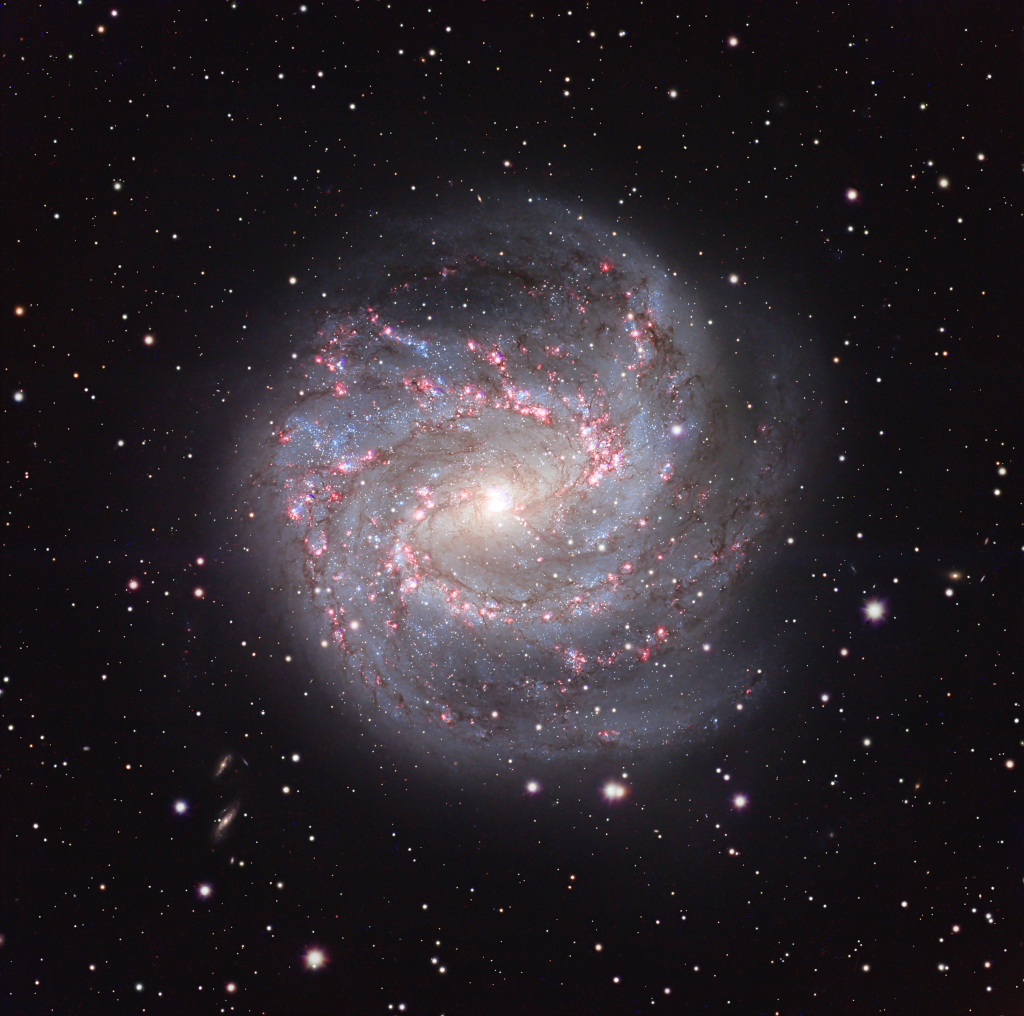
Southern Pinwheel (M83)
The Southern Pinwheel, near enough that individual knots of star formation turn up in amateur photographs. Six supernovae in the last century — a galaxy that keeps losing stars loudly. Too far south for most of Europe to see it properly.
It is a barred spiral of the same broad kind as ours, seen almost exactly face-on, and near enough that individual star clusters and dust lanes resolve in a large amateur telescope from a southern site. Two nuclei have been found at its centre, which is the usual sign of a merger that has not finished.
- Catalogue
- M83
- Type
- Galaxy
- Constellation
- Hydra
- Distance
- 15 million light-years
- Apparent magnitude
- 7.6
- Surface brightness
- 21.3 mag/□″
- Apparent size
- 11′ × 10′
- Right ascension
- 13h 37m
- Declination
- −29.87°
- Found by
- Nicolas-Louis de Lacaille, 1752
Small enough that its 7.6 magnitudes arrive concentrated rather than smeared: 21.3 per square arcsecond, which is why it stands out from the sky better than its brightness alone suggests. Why surface brightness is the number that matters.
Could you see it?
Straightforward with the naked eye from Bortle 1 or darker; with 10×50 binoculars from Bortle 5.
| Sky | Eye | 10×50 | 80mm | 130mm | 200mm |
|---|---|---|---|---|---|
| Bortle 1 21.9 mag/□″ | Easy | Easy | Easy | Easy | Easy |
| Bortle 2 21.7 mag/□″ | No | Easy | Easy | Easy | Easy |
| Bortle 3 21.4 mag/□″ | No | Easy | Easy | Easy | Easy |
| Bortle 4 20.9 mag/□″ | No | Easy | Easy | Easy | Easy |
| Bortle 5 20.3 mag/□″ | No | Easy | Easy | Easy | Easy |
| Bortle 6 19.3 mag/□″ | No | Challenge | Challenge | Challenge | Challenge |
| Bortle 7 18.6 mag/□″ | No | Challenge | Challenge | Challenge | Challenge |
| Bortle 8 18.1 mag/□″ | No | No | No | No | No |
| Bortle 9 17.8 mag/□″ | No | No | No | No | No |
At the eyepiece
From the southern hemisphere one of the finest galaxies anywhere, with the bar and the beginnings of arms at 200mm. From Britain it barely clears the murk and there is nothing to be done about it. One of the strongest arguments in this catalogue for travelling.
When, and from where
Highest in the middle of the night in April. A southern object: overhead at 30°S, and low and murky from Britain and the northern United States even at its best. North of 60°N it never rises.
| Latitude | Highest it gets | |
|---|---|---|
| 60°N Oslo, Anchorage | 0° | Low — in the murk |
| 51°N London, Calgary | 9° | Low — in the murk |
| 40°N New York, Madrid | 20° | |
| 30°N Cairo, Houston | 30° | |
| 0°N the equator | 60° | |
| 33°S Sydney, Cape Town | 87° |
In the archive
Nearby in the sky
The whole catalogue →Nothing else in the catalogue is especially close; the nearest is 13° apart, which is a separate trip rather than a nudge of the tube. Everything below is measured from M83 itself, not from the middle of Hydra.
- M68 Globular cluster 13° apart Hydra · magnitude 7.8 · binoculars from Bortle 5 or darker
- M104 Sombrero Galaxy 23° apart Virgo · magnitude 8.0 · binoculars from Bortle 6 or darker
- M80 Globular cluster 36° apart Scorpius · magnitude 7.3 · binoculars from Bortle 6 or darker
- M4 Globular cluster 37° apart Scorpius · magnitude 5.6 · binoculars from Bortle 5 or darker
One of 110. Positions J2000; the sky is the final authority.