Galaxy in Andromeda
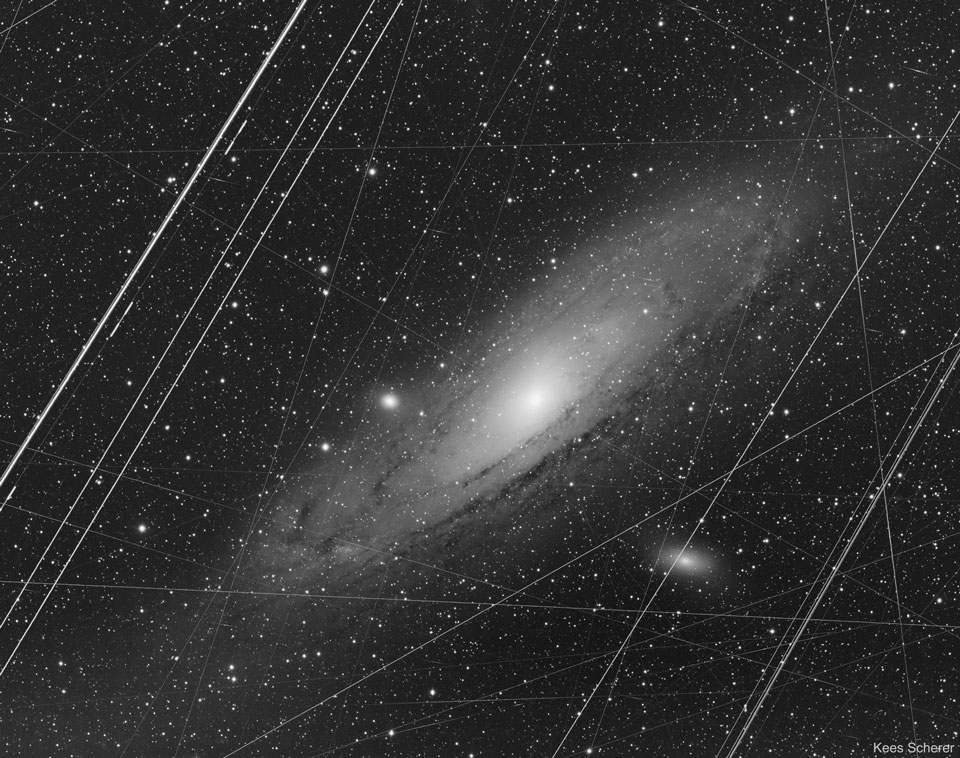
Andromeda Galaxy (M31)
The object that settled the largest argument in astronomy: in 1923 Edwin Hubble found a Cepheid variable in it and proved it was not a cloud inside our own galaxy but a galaxy in its own right. What the naked eye picks up is only the bright core — the full span is six times the width of the Moon.
It is coming toward us at about 110 kilometres a second and will arrive in something over four billion years, after which neither galaxy will be a spiral. It also holds a couple of thousand globular clusters to our own's hundred and fifty, which was one of the earliest hints that it is the larger of the two.
- Catalogue
- M31
- Type
- Galaxy
- Constellation
- Andromeda
- Distance
- 2.5 million light-years
- Apparent magnitude
- 3.4
- Surface brightness
- 22.2 mag/□″
- Apparent size
- 190′ × 60′
- Right ascension
- 0h 43m
- Declination
- +41.27°
- Found by
- Abd al-Rahman al-Sufi, AD 964
Its light is spread across 190′, which is why a catalogue magnitude of 3.4 is so misleading here — averaged over that area it comes out at 22.2 per square arcsecond, fainter than the sky from most places. Why surface brightness is the number that matters.
Could you see it?
Straightforward from a Bortle 4 sky or darker, and aperture makes almost no difference to that — spread this thinly, an object is limited by how bright the sky behind it is rather than by how much light the telescope collects. A darker site beats a bigger telescope.
| Sky | Eye | 10×50 | 80mm | 130mm | 200mm |
|---|---|---|---|---|---|
| Bortle 1 21.9 mag/□″ | Easy | Easy | Easy | Easy | Easy |
| Bortle 2 21.7 mag/□″ | Easy | Easy | Easy | Easy | Easy |
| Bortle 3 21.4 mag/□″ | Easy | Easy | Easy | Easy | Easy |
| Bortle 4 20.9 mag/□″ | Easy | Easy | Easy | Easy | Easy |
| Bortle 5 20.3 mag/□″ | Challenge | Challenge | Challenge | Challenge | Challenge |
| Bortle 6 19.3 mag/□″ | No | No | No | No | No |
| Bortle 7 18.6 mag/□″ | No | No | No | No | No |
| Bortle 8 18.1 mag/□″ | No | No | No | No | No |
| Bortle 9 17.8 mag/□″ | No | No | No | No | No |
At the eyepiece
The commonest disappointment in amateur astronomy, entirely because of expectations. A telescope shows the core and almost nothing else; binoculars from a dark site show the extent, which is the impressive part. Look for the dust lanes on the north-west side with 150mm and averted vision.
When, and from where
Highest in the middle of the night in September. Well placed for the northern hemisphere and overhead for anyone near 41°N. South of 49°S it stays below the horizon.
| Latitude | Highest it gets | |
|---|---|---|
| 60°N Oslo, Anchorage | 71° | Never sets |
| 51°N London, Calgary | 80° | Never sets |
| 40°N New York, Madrid | 89° | |
| 30°N Cairo, Houston | 79° | |
| 0°N the equator | 49° | |
| 33°S Sydney, Cape Town | 16° | Low — in the murk |
In the archive
Nearby in the sky
The whole catalogue →2 more of the catalogue sit within five degrees, close enough to take in on the same night without moving far. Everything below is measured from M31 itself, not from the middle of Andromeda.
- M32 Galaxy 24′ apart Andromeda · magnitude 8.1 · binoculars from Bortle 5 or darker
- M110 Galaxy 36′ apart Andromeda · magnitude 8.5 · binoculars from Bortle 3 or darker
- M76 Little Dumbbell 15° apart Perseus · magnitude 10.1 · binoculars from Bortle 4 or darker
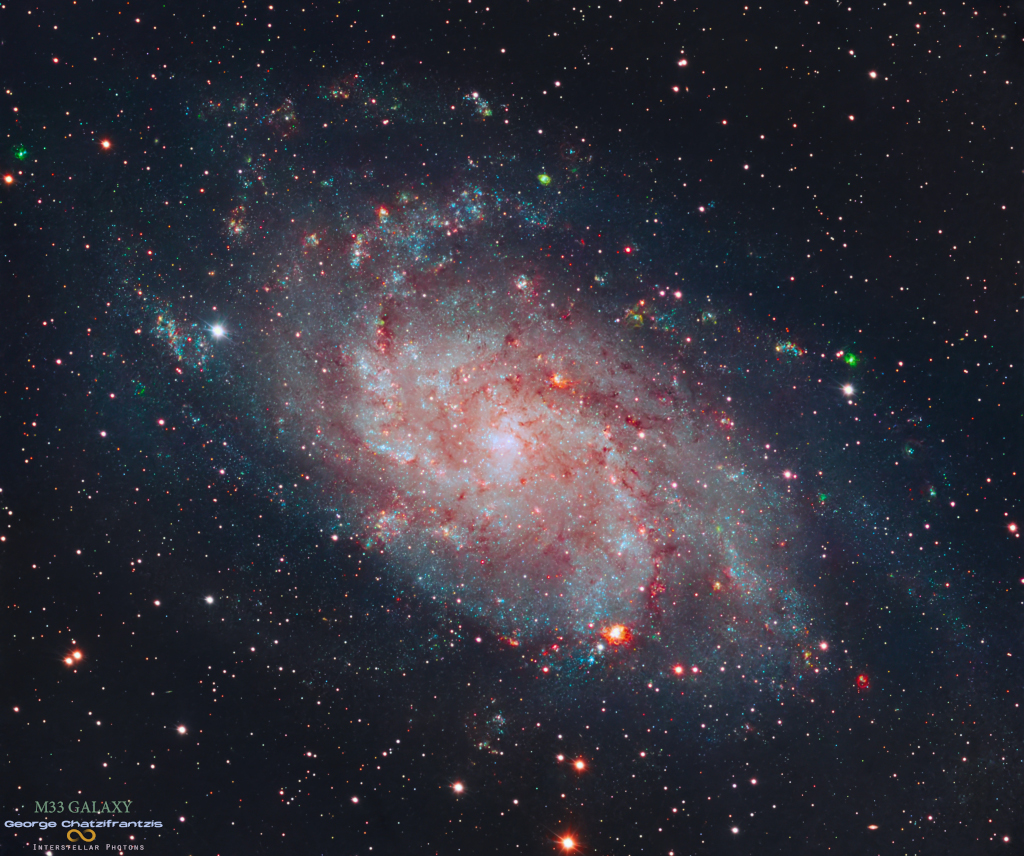
- M33 Triangulum Galaxy 15° apart Triangulum · magnitude 5.7 · binoculars from Bortle 3 or darker
Terms on this page
- Cepheid variable A star that pulses at a rate set by its true brightness, which is how the universe got measured.
One of 110. Positions J2000; the sky is the final authority.