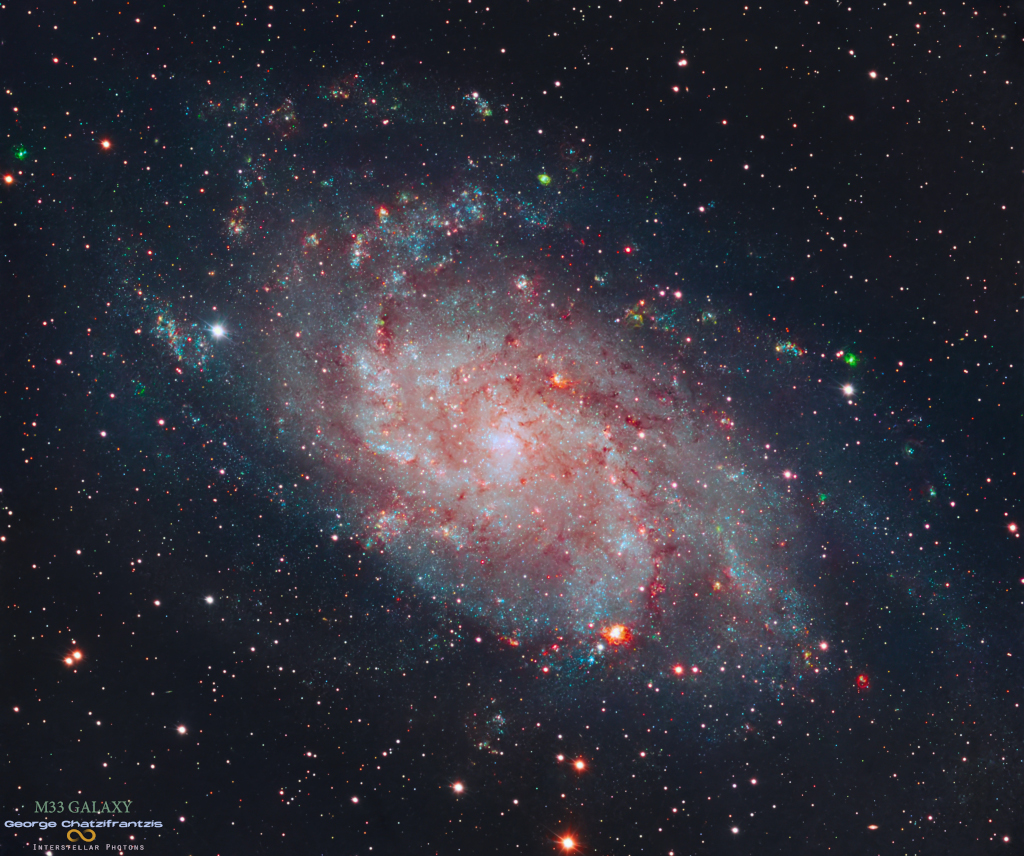
Galaxy in Triangulum
Triangulum Galaxy (M33)
The standard test of how dark a sky really is. Its light is spread so thinly that it is easier to see with the naked eye from a genuinely dark site than through a telescope from a poor one — a fact that catches out people who have just bought a telescope.
It is the third-largest member of the Local Group and the smallest thing anybody can reasonably claim to have seen with the naked eye. It also holds the most luminous X-ray source in the Local Group, a black hole of about fifteen solar masses eclipsed by its companion every three and a half days — the only stellar-mass black hole whose mass has been weighed that directly.
- Catalogue
- M33
- Type
- Galaxy
- Constellation
- Triangulum
- Distance
- 2.7 million light-years
- Apparent magnitude
- 5.7
- Surface brightness
- 22.9 mag/□″
- Apparent size
- 70′ × 40′
- Right ascension
- 1h 34m
- Declination
- +30.65°
- Found by
- Giovanni Batista Hodierna, before 1654
Magnitude 5.7 sounds comfortable and is spread over 70′, which brings it down to 22.9 per square arcsecond — the number that actually decides whether there is anything to see. Why surface brightness is the number that matters.
Could you see it?
Straightforward from a Bortle 3 sky or darker, and aperture makes almost no difference to that — spread this thinly, an object is limited by how bright the sky behind it is rather than by how much light the telescope collects. A darker site beats a bigger telescope.
| Sky | Eye | 10×50 | 80mm | 130mm | 200mm |
|---|---|---|---|---|---|
| Bortle 1 21.9 mag/□″ | Easy | Easy | Easy | Easy | Easy |
| Bortle 2 21.7 mag/□″ | Easy | Easy | Easy | Easy | Easy |
| Bortle 3 21.4 mag/□″ | Easy | Easy | Easy | Easy | Easy |
| Bortle 4 20.9 mag/□″ | Challenge | Challenge | Challenge | Challenge | Challenge |
| Bortle 5 20.3 mag/□″ | No | Challenge | Challenge | Challenge | Challenge |
| Bortle 6 19.3 mag/□″ | No | No | No | No | No |
| Bortle 7 18.6 mag/□″ | No | No | No | No | No |
| Bortle 8 18.1 mag/□″ | No | No | No | No | No |
| Bortle 9 17.8 mag/□″ | No | No | No | No | No |
At the eyepiece
The object that teaches people what their sky is actually worth. Under proper darkness it is a large, obvious glow in binoculars and the arms come out at 150mm with low power. From a suburban garden it is simply absent, at any aperture. Nothing else here is a fairer test.
When, and from where
Highest in the middle of the night in October. Passes overhead at 31°N and rises from everywhere except the far south — below 59°S it never clears the horizon.
| Latitude | Highest it gets | |
|---|---|---|
| 60°N Oslo, Anchorage | 61° | Never sets |
| 51°N London, Calgary | 70° | |
| 40°N New York, Madrid | 81° | |
| 30°N Cairo, Houston | 89° | |
| 0°N the equator | 59° | |
| 33°S Sydney, Cape Town | 26° |
In the archive
Nearby in the sky
The whole catalogue →Nothing else in the catalogue is especially close; the nearest is 15° apart, which is a separate trip rather than a nudge of the tube. Everything below is measured from M33 itself, not from the middle of Triangulum.
- M32 Galaxy 15° apart Andromeda · magnitude 8.1 · binoculars from Bortle 5 or darker
- M31 Andromeda Galaxy 15° apart Andromeda · magnitude 3.4 · binoculars from Bortle 4 or darker
- M74 Phantom Galaxy 15° apart Pisces · magnitude 9.4 · binoculars from Bortle 3 or darker
- M110 Galaxy 15° apart Andromeda · magnitude 8.5 · binoculars from Bortle 3 or darker
One of 110. Positions J2000; the sky is the final authority.